Creative Storytelling Activities to Enhance Preschool Language Development
The preschool years are a period of astonishing linguistic growth. Between the ages of three and five, children transition from simple utterances to complex sentences, expanding their vocabulary at an incredible rate. This foundational language development isn't just about speaking – it's intricately linked to cognitive skills, social-emotional growth, and future academic success. One of the most powerful, and delightfully engaging, ways to nurture this development is through creative storytelling. Moving beyond simply reading stories, actively creating them allows children to take ownership of language, practicing narrative structure, expanding their vocabulary in context, and honing their ability to express thoughts and ideas.
Traditional approaches to early literacy often prioritize letter recognition and phonics, which are, of course, important. However, focusing solely on decoding skills can sometimes overshadow the joy of language and the critical skill of communication. Storytelling activities actively encourage children to use language meaningfully, building confidence and fostering a lifelong love of words. It’s about building a communicative ecosystem where children feel safe to experiment, make mistakes, and ultimately, find their voice.
This article will explore a variety of creative storytelling activities specifically designed to enhance language development in preschoolers, providing practical tips and examples to empower parents and educators to cultivate a rich linguistic environment. We'll delve into the ‘why’ behind these activities, connecting them to established research in early childhood education, and showcasing how to tailor them to individual needs and learning styles.
- Storytelling with Story Stones
- Collaborative Story Building: “Once Upon a Time…”
- Puppet Show Performances: Bringing Characters to Life
- Picture Prompt Storytelling: A Visual Starting Point
- Sound Effect Stories: Engaging Auditory Imagination
- Story Retelling with Variations: Building Comprehension & Fluency
- Conclusion: Fostering a Lifelong Love of Language
Storytelling with Story Stones
Story stones are a beautifully tactile and versatile tool for fostering narrative skills. This activity involves collecting smooth, flat stones (either naturally or purchased) and decorating them with permanent markers depicting characters, settings, objects, and actions. The beauty of story stones lies in their open-ended nature; there's no right or wrong way to use them. Children can randomly select stones and weave a tale based on the images, prompting them to think creatively and articulate their thoughts.
To begin, involve the children in creating the story stones themselves! This initial act of creation adds another layer of engagement and ownership. Discuss different elements of a story – "What kinds of characters do stories have?" "Where do stories take place?" "What things might characters use?" – as you draw together. Then, the activity itself can be structured loosely. Encourage the child to pick three to five stones and tell you a story connecting the images. Ask prompting questions like, "What is the character feeling?" or "What happens next?" Avoid interjecting with a specific storyline; allow their imagination to lead the way. The focus is on process, not perfection.
Furthermore, story stones can be adapted to focus on specific language skills. For example, if a child struggles with using adjectives, deliberately include stones depicting qualities (e.g., a ‘happy’ face, a ‘big’ tree, a ‘blue’ car). Encourage them to incorporate these descriptors into their storyline. This is a prime example of embedding language goals within play, making learning organic and enjoyable.
Collaborative Story Building: “Once Upon a Time…”
Collaborative storytelling immediately introduces the social aspect to language development. It’s a fantastic way to build turn-taking skills, active listening, and the ability to expand on another person’s ideas. This activity relies on a simple starting phrase – “Once upon a time…” – and then each participant adds a sentence or two to continue the narrative, building the story one piece at a time.
The key to successful collaborative storytelling is creating a supportive and non-judgmental atmosphere. Emphasize that all contributions are valuable, no matter how silly or unconventional they may seem. Start the story yourself, providing an intriguing opening sentence, and then prompt the child to add to it. For example: "Once upon a time, there was a tiny purple dragon who loved to bake cookies…". Then ask, “What happened next?” Or “Where did the dragon bake the cookies?” Be prepared to model flexible thinking and embrace unexpected plot twists. The goal isn’t a perfectly coherent story, but rather a shared creative experience.
To increase the language complexity, introduce specific elements children have to incorporate. For instance, you might challenge them to include a problem the character faces and how they solve it, or to introduce a new character with a unique characteristic. “Remember to have your character face a problem!” or “Let’s introduce a new character who loves to sing!” This forces them to use more sophisticated vocabulary and sentence structures.
Puppet Show Performances: Bringing Characters to Life
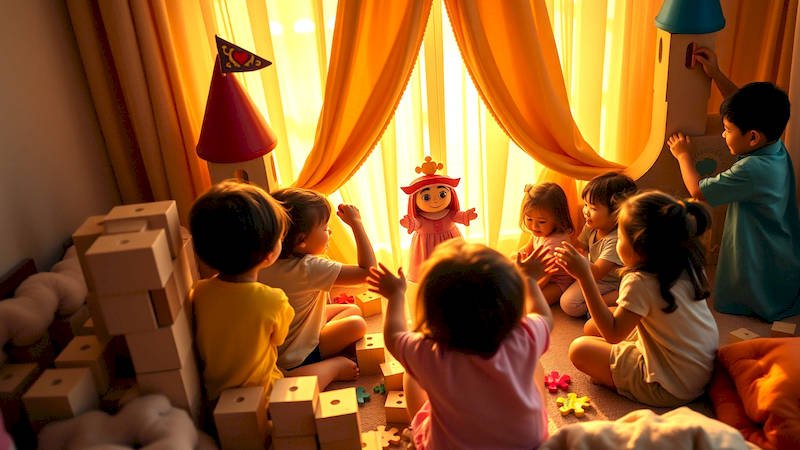
Puppet shows provide a captivating medium for children to embody different characters and practice narrative storytelling. The inherent anonymity of puppets can also lower inhibitions, allowing children who might be shy to express themselves more freely. Whether you use store-bought puppets, create them from socks, or simply use fingers as characters, the act of manipulating a puppet and giving it a voice encourages imaginative play and language exploration.
Begin by exploring different puppet types. Discuss how different puppets might move and speak, connecting the physical characteristics to personality traits. For instance, “Does this grumpy-looking puppet have a loud voice or a quiet voice?” Then, encourage the child to develop a simple storyline. This doesn’t need to be complex initially – it could be as simple as a puppet going on an adventure or visiting a friend. Help them brainstorm ideas for dialogue, encouraging them to use different voices for each character. The act of voicing a puppet forces them to practice vocal modulation and expressive language.
Consider recording the puppet show! This offers a great opportunity for reflection and self-assessment. After the performance, watch the recording together, discussing what worked well and what could be improved. “I loved how you gave the bear a rumbling voice!” or “Maybe we could add more details to the setting next time.”
Picture Prompt Storytelling: A Visual Starting Point
Picture prompts offer a powerful visual stimulus for sparking imagination and inspiring storytelling. Instead of starting with a blank slate, children are provided with a single image or a series of images as a starting point for their narrative. These images can be anything – photographs, illustrations, paintings, or even magazine cutouts.
The effectiveness of picture prompts lies in their ability to bypass initial creative blocks. Sometimes, a blank page can be daunting; a picture provides a concrete anchor point. You can ask open-ended questions about the picture: “What is happening in this picture?” or “Who are these people?” or “Where do you think this place is?” Then, encourage the child to build a story around the image. "Tell me a story about this little girl and her dog." Or “What happened before this picture was taken?” Or “What will happen after this picture?”
Variety is key with picture prompts. Use images depicting a range of emotions, settings, and characters. Consider providing a series of images that tell a fragmented story, and ask the child to fill in the gaps. This encourages inference and higher-level thinking skills.
Sound Effect Stories: Engaging Auditory Imagination
This unique activity shifts the focus from visual cues to auditory stimulation. Begin by creating a collection of everyday objects that produce distinctive sounds – a crinkling plastic bag, a jingling set of keys, a whistling kettle, a tapping pencil, etc. Then, present the child with one sound at a time and ask them to incorporate it into a story.
The challenge lies in integrating the sound organically into the narrative. It isn’t enough to simply mention the sound; the child must find a creative way to make it a meaningful part of the story. For example, if you play the sound of jingling keys, the child might say, "The fairy needed to unlock the secret garden gate, so she jangled her keys excitedly." This activity encourages descriptive language, sound mimicry, and the ability to create a vivid auditory landscape. It’s a really powerful way to work on onomatopoeia without explicitly teaching it!
Extend this activity by having the child create the sound effects themselves. This adds another layer of engagement and encourages them to explore different ways of producing sounds. You can even create a "sound effects library" together, labeling each object and its corresponding sound.
Story Retelling with Variations: Building Comprehension & Fluency
While creating entirely new stories is vital, practicing retelling familiar stories with slight variations strengthens comprehension, vocabulary retention, and narrative fluency. Choose a favourite story the child knows well, and then introduce a simple change — such as altering a character's motivation, changing the setting, or adding a new obstacle.
Present the alteration clearly. For instance, “Let’s tell the story of ‘The Three Little Pigs’ but this time, the wolf is actually trying to borrow a cup of sugar!” Then, encourage the child to retell the story incorporating the new element. This requires them to actively engage with the original narrative, understanding the plot and characters well enough to adapt it creatively. It’s a wonderful way to assess their understanding of story structure.
To support them, you can provide sentence starters or leading questions. “What would the first little pig do if the wolf wanted sugar?” or “How might the story change if the pigs lived in a jungle instead of a meadow?” Encourage them to explain why they made the changes they did, prompting them to articulate their reasoning.
Conclusion: Fostering a Lifelong Love of Language
Creative storytelling activities are far more than just playful pastimes; they are fundamental building blocks for robust language development in preschoolers. By engaging in these practices, children not only expand their vocabulary and master narrative structures but also cultivate critical thinking skills, enhance their social-emotional intelligence, and develop a lifelong love of language and stories. Remember, the process is significantly more important than the product – embracing their unique storytelling style, valuing their imaginative contributions, and creating a supportive, non-judgmental environment are paramount.
The key takeaways from this exploration are the importance of providing open-ended opportunities, adapting activities to individual needs, and integrating language goals seamlessly into play. As parents and educators, our role is to be facilitators, offering prompts and encouragement, but ultimately allowing the children’s imaginations to soar. Start small – implement one or two of these activities each week and observe the remarkable growth in their linguistic abilities. The seeds of confident communication are sown in the playful, imaginative space of childhood storytelling.
Deja una respuesta