Building Problem-Solving through LEGO Challenges in STEM Education
In an increasingly complex world, nurturing problem-solving skills in children is paramount. These skills aren’t just valuable for future STEM careers; they’re foundational for navigating life’s challenges, fostering creativity, and developing critical thinking abilities. While traditional education often emphasizes rote memorization, the shift towards hands-on, experiential learning is gaining momentum. Enter LEGO – a seemingly simple toy that’s proving to be a powerful tool for unlocking STEM potential and cultivating robust problem-solving capabilities. This article will delve into how purposeful LEGO challenges can be integrated into a child’s education, explore the underlying STEM principles at play, and provide practical guidelines for parents and educators.
The beauty of LEGO lies in its open-ended nature. Unlike many toys with prescribed uses, LEGO bricks invite exploration, experimentation, and iterative design. This freedom, combined with the inherent engineering principles involved in building, naturally fosters a problem-solving mindset. Beyond the sheer fun of creation, LEGO challenges can specifically target areas like spatial reasoning, computational thinking, and collaborative teamwork. They provide a safe, engaging environment for children to fail, reflect, and refine their approach – vital steps in the problem-solving process. The goal isn't necessarily to build a perfect model, but to learn how to approach a problem effectively.
- The Neuroscience Behind LEGO & Problem Solving
- Designing Effective LEGO Challenges: Beyond Following Instructions
- Integrating STEM Principles Through LEGO
- LEGO and Computational Thinking: Coding Without a Computer
- Fostering Collaboration and Communication
- Adapting LEGO Challenges for Different Age Groups
- Conclusion: Building a Foundation for Future Success
The Neuroscience Behind LEGO & Problem Solving
The connection between play, particularly construction-based play like LEGO, and brain development is well-documented. Building with LEGO activates multiple areas of the brain, including those responsible for spatial reasoning, motor skills, and planning. Neuroplasticity, the brain’s ability to reorganize itself by forming new neural connections, is significantly enhanced through these types of activities. When a child encounters a building challenge, their brain actively searches for solutions, creating and strengthening pathways associated with problem-solving.
Furthermore, the iterative nature of LEGO building encourages a growth mindset. When a structure collapses or a design doesn’t work as intended, children learn to view failure not as a final outcome, but as a learning opportunity. This resilience and willingness to experiment are critical characteristics of successful problem-solvers. According to Dr. Gabriella Gomes, a neuroscientist specializing in childhood development, "Construction play like LEGO isn’t just about building something tangible; it's about building cognitive resilience. The act of repeatedly trying, failing, and adapting strengthens the neural pathways involved in problem-solving and learning from mistakes." This directly impacts future academic performance and real-world adaptability.
Designing Effective LEGO Challenges: Beyond Following Instructions
While following the instructions provided in LEGO sets has its value (enhancing reading comprehension and attention to detail), the true learning potential lies in unstructured challenges. Instead of providing step-by-step guidance, present children with a problem to solve using the LEGO bricks available. This forces them to think critically, plan strategically, and experiment with different solutions. Good challenges are open-ended, allowing for multiple correct answers, and encourage collaboration.
For example, instead of asking a child to build a specific car, pose a challenge like, “Build a vehicle that can travel the furthest distance when rolled down a ramp.” Or, “Design a structure that can withstand a simulated earthquake (gentle shaking).” These prompts require the child to define requirements, brainstorm solutions, prototype, test, and iterate. Start with simpler challenges for younger children and gradually increase the complexity as their skills develop. Consideration should be given to the age and prior experience of the child when formulating a challenge; a task too easy will be unengaging, while a task too hard will be frustrating.
Integrating STEM Principles Through LEGO
LEGO challenges provide an excellent opportunity to subtly introduce and reinforce fundamental STEM concepts. Engineering principles like structural integrity, load-bearing capacity, and simple machines become immediately apparent when attempting to build stable structures or functional mechanisms. Mathematical concepts like symmetry, geometry, and measurement are naturally integrated when planning and executing designs. Physics principles can be explored through experiments involving motion, gravity, and force.
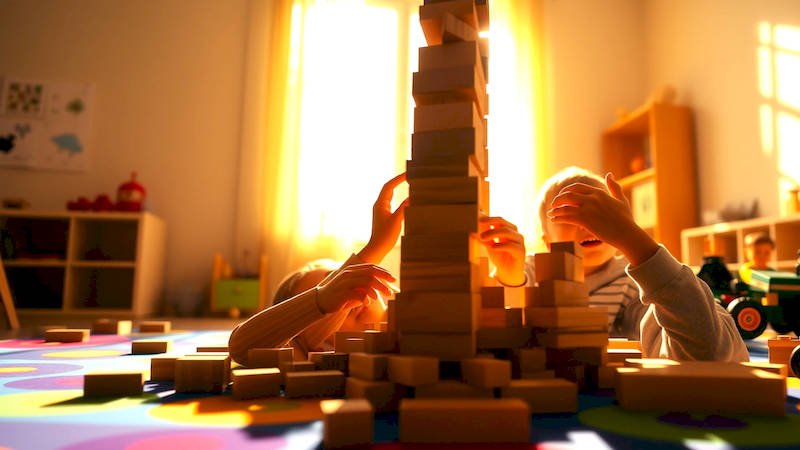
For instance, a challenge to build the tallest tower can lead to a discussion about the importance of a wide base and structural supports. Building a functioning pulley system using LEGO bricks allows children to explore the mechanical advantage offered by simple machines. Don’t directly lecture on these principles; instead, encourage children to discover them through experimentation and observation. Ask guiding questions like, “What happens if you change the width of the base?” or “How can you make the tower more stable?” leading them to independently explore the concepts.
LEGO and Computational Thinking: Coding Without a Computer
Computational thinking, a problem-solving methodology used in computer science, is increasingly recognized as an essential skill for the 21st century. It involves breaking down complex problems into smaller, more manageable steps, identifying patterns, and developing algorithms (step-by-step instructions). LEGO challenges can be cleverly used to foster computational thinking skills without a computer.
Consider a challenge where a child needs to design a LEGO “robot” that can navigate a maze. They need to break down the maze into individual steps, identify the optimal path, and create a sequence of instructions for their robot to follow. This process mirrors the fundamental principles of coding: decomposition, pattern recognition, abstraction, and algorithm design. Resources like LEGO Education’s SPIKE Prime set explicitly integrate these concepts. However, even with basic bricks, you can encourage algorithmic thinking by asking children to write down the steps involved in their build or to explain their design logic to others.
Fostering Collaboration and Communication
Problem-solving isn’t always a solo endeavor; often, the best solutions emerge from collaborative efforts. LEGO challenges are naturally conducive to teamwork, requiring children to communicate effectively, share ideas, and negotiate solutions. Assign challenges that require multiple builders, each with specific roles and responsibilities. Encourage children to discuss their ideas, explain their reasoning, and listen to the perspectives of others.
Effective communication is as crucial as technical skill. Have children present their designs, explaining the challenges they faced, the solutions they implemented, and what they learned from the process. This not only reinforces their understanding but also develops their public speaking and presentation skills. The key is to define clear roles within the group and encourage active listening ensuring all team members contribute equally.
Adapting LEGO Challenges for Different Age Groups
The complexity of LEGO challenges should be tailored to the developmental stage of the child. For younger children (ages 4-6), focus on simple building tasks that emphasize creativity and spatial reasoning. Challenges like building the tallest tower, creating a house for a LEGO figurine, or constructing a simple vehicle are appropriate. For children ages 7-9, introduce more complex challenges that incorporate basic engineering principles. Building bridges, designing simple machines, or creating structures that meet specific criteria are good options.
For older children (ages 10+), explore more advanced challenges that require computational thinking and problem-solving skills. Creating LEGO robots, designing automated systems, or solving complex engineering problems are suitable. Furthermore, introduce constraints – limitations on the number of bricks, time limits, or specific materials – to increase the problem-solving challenge. Regularly revisit and update challenges to maintain engagement and continue fostering growth.
Conclusion: Building a Foundation for Future Success
Integrating LEGO challenges into a child’s learning experience is a powerfully effective way to cultivate essential STEM skills and foster a lifelong love of learning. Beyond the tangible creations, the real value lies in the development of critical thinking, problem-solving, and collaborative abilities. By moving beyond simply following instructions and embracing open-ended challenges, parents and educators can unlock a child’s potential for innovation and creativity. Remember, the goal isn't to build the 'right' answer, but to empower children to approach problems with confidence, resilience, and a growth mindset.
Key takeaways include: prioritize unstructured challenges; integrate STEM principles subtly through experimentation; encourage computational thinking without relying on computers; foster collaboration and communication; and adapt challenges to age-appropriate levels. The next step is simple: gather some LEGO bricks, pose a challenge, and watch as your child's imagination and problem-solving skills come to life. By doing so, you’re not just building with LEGOs; you’re building a foundation for future success.
Deja una respuesta