
Integrating Basic Science Concepts into Everyday Play for Toddlers
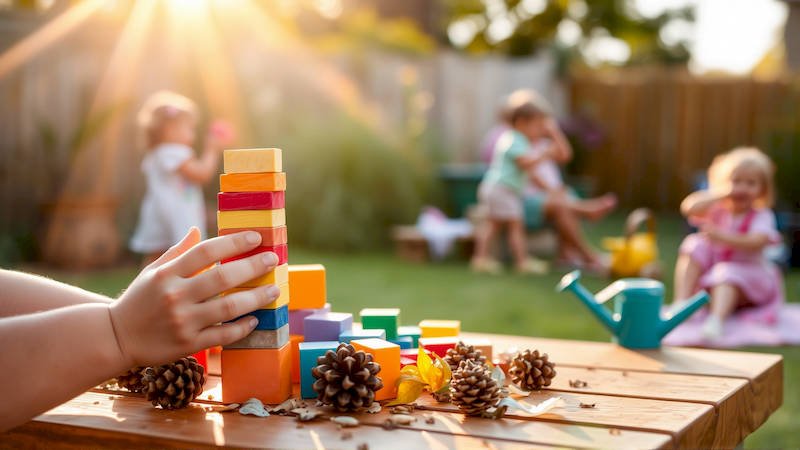
Toddlers are natural scientists. Their world is a vast laboratory filled with wonder, experimentation, and a burning desire to understand how things work. From banging pots and pans to observing bubbles, they’re constantly testing boundaries, exploring properties, and laying the foundational blocks for future scientific thinking. As parents, we often underestimate the power of these seemingly simple explorations. But what if we intentionally fostered this inherent curiosity by weaving basic science concepts into their everyday play? This isn’t about turning toddlers into lab technicians; it's about providing a rich, stimulating environment that encourages observation, questioning, and a lifelong love of learning.
The early years are critical for brain development. Neuroscientific research consistently demonstrates that experiences during the first five years significantly shape a child’s cognitive architecture. Introducing foundational science concepts, even in a playful manner, stimulates neural pathways and builds a strong foundation for future STEM (Science, Technology, Engineering, and Mathematics) education. Moreover, integrating science into play doesn’t require special equipment or structured lessons. It's about reframing how we approach playtime, offering open-ended opportunities for exploration, and asking questions that spark curious minds.
This article will provide practical strategies and ideas for seamlessly incorporating fundamental science concepts – physics, chemistry, biology, and earth science – into your toddler’s daily routine, transforming everyday moments into valuable learning experiences. We'll move beyond simply providing toys and delve into how to engage with those toys and everyday objects to maximize scientific discovery. Let’s unlock the scientist within your little one!
- Understanding the Foundations: Why Science Play Matters for Toddlers
- Exploring Physics Through Play: Gravity, Motion, and Simple Machines
- Chemistry in the Kitchen: Mixing, Measuring, and Observing Reactions
- Biology Unveiled: Exploring Living Things and Their Environments
- Earth Science Adventures: Weather, Rocks, and the World Around Us
- Conclusion: Nurturing a Lifelong Love of Science
Understanding the Foundations: Why Science Play Matters for Toddlers
Early exposure to science isn’t merely about memorizing facts; it's about developing critical thinking skills. Through experimentation, toddlers learn about cause and effect, problem-solving, and the importance of observation. When a child builds a tower with blocks and it topples over, they’re learning about gravity, balance, and structural integrity – concepts that form the basis of physics. Similarly, mixing paint colors introduces them to the basics of chemistry and how substances interact. These experiences build a foundational understanding that will serve them well throughout their lives.
A key aspect of science play is fostering a growth mindset. Focusing on the process of discovery, rather than getting the “right” answer, encourages resilience and a willingness to try again after failures. Dr. Carol Dweck’s research on mindset reveals that children who believe intelligence is malleable (can be developed through effort) are more likely to embrace challenges and persist in the face of setbacks. By praising exploration and effort over outcome, we help toddlers develop this essential belief. For example, instead of saying, "Good job building a tall tower!" try, "You worked really hard to balance those blocks. I wonder what would happen if you tried a wider base?"
Moreover, integrating science into play can strengthen parent-child bonds. Engaging in shared exploration and experimentation provides opportunities for meaningful interaction and quality time. It moves away from a traditional teacher-student dynamic and fosters a collaborative learning environment where both parent and child are actively curious and engaged. This shared experience can also open up conversations about the world around us, expanding your toddler’s vocabulary and their understanding of complex concepts.
Exploring Physics Through Play: Gravity, Motion, and Simple Machines
Physics, at its core, is the study of matter and its motion through space and time. Toddlers intuitively grapple with physical concepts every day – pushing cars, dropping objects, observing how things roll. The trick is to highlight these natural investigations and extend them with playful explorations. Providing a variety of balls (different sizes, materials, weights) and ramps offers a simple yet effective way to investigate gravity and motion. Encourage your toddler to experiment with different angles and observe how it affects the speed and distance the ball travels.
Simple machines like levers, wheels, and pulleys can be introduced through playful construction sets or everyday objects. A sturdy cardboard box can become a ramp for rolling toys (inclined plane), and a collection of different-sized pots and pans can be used to experiment with sound (vibration). Building towers with blocks isn't just about stacking; it's an exercise in structural engineering. Ask questions like, "What happens if we put the bigger blocks at the bottom?" or "How can we make the tower more stable?” These questions nudge them to think critically about weight distribution and balance.
Consider creating an "obstacle course" using pillows, blankets, and furniture. This encourages gross motor skills development while also implicitly teaching principles of motion and spatial awareness. Narrate what’s happening – “You’re pushing against the pillow, that’s a force! You’re going faster down the slope!” – to subtly reinforce the underlying concepts.
Chemistry in the Kitchen: Mixing, Measuring, and Observing Reactions
Chemistry often seems complex, but the basic principles of mixing and reacting are easily accessible to toddlers. Simple kitchen activities can provide a wealth of chemical exploration. Playing with water and different ingredients like baking soda and vinegar is a classic example, creating a bubbly “volcano” that demonstrates a chemical reaction (acid-base neutralization). Always supervise closely, and emphasize that these ingredients are not for tasting.
Baking itself is a fantastic chemistry lesson! Toddlers can help measure ingredients, stir mixtures, and observe how the ingredients transform as they’re combined and heated. Talk about how the flour changes when you add water or how the sugar dissolves. These are all examples of chemical changes occurring right before their eyes. Focus on observation and description ("The batter is getting thicker") rather than explaining the biochemical processes in detail.
Even simple activities like making playdough allow for chemical exploration. The process of combining flour, salt, water, and oil demonstrates how different substances combine to create a new material with unique properties. Discuss the texture and how it changes as you manipulate it. Emphasising the observation of different textures and surfaces can lay the foundations for understanding molecular properties.
Biology Unveiled: Exploring Living Things and Their Environments
Toddlers are naturally fascinated by living things – plants, animals, and themselves! Gardening is an excellent way to introduce basic biological concepts. Planting seeds and observing their growth teaches about life cycles, the importance of sunlight and water, and the interconnectedness of living things. Discuss what plants need to survive and how they change over time.
Even if you don't have a garden, you can grow herbs or vegetables in small pots indoors. Observing insects in your garden or backyard also introduces them to the diversity of life and the concept of ecosystems. Talk about where the insects live and what they eat. Bring in books with pictures of different animals and plants, and encourage your toddler to identify and categorize them.
Talking about the human body is another way to explore biology. Discuss body parts (head, shoulders, knees, toes!) and their functions in a straightforward manner. When your child is sick, explain that their body is fighting off germs (without getting into complex immunology). Simple explanations can spark curiosity about how their bodies work.
Earth Science Adventures: Weather, Rocks, and the World Around Us
Earth science explores the natural world around us, from the weather to the rocks beneath our feet. Even something as simple as looking at the clouds can be an earth science lesson. Talk about the different shapes and colors of the clouds and how they might indicate different weather conditions. Go outside during rainy or snowy weather and observe the changes in the environment.
Collecting rocks and leaves during nature walks introduces toddlers to the diversity of Earth's materials. Discuss the different colors, textures, and sizes of the rocks. Talk about where they might have come from. You can even create a “nature museum” with your collected treasures, encouraging your toddler to categorize and label them.
Simple experiments like making a miniature rain gauge can also teach about weather and measurement. Discuss how much rain falls in different locations and how it affects the environment. Connecting these lessons to everyday experiences, like watering plants or needing an umbrella, will make the concepts more relatable and memorable.
Conclusion: Nurturing a Lifelong Love of Science
Integrating basic science concepts into everyday play isn't about rigorous instruction; it's about fostering curiosity, encouraging exploration, and nurturing a lifelong love of learning. By reframing playtime as a laboratory for discovery, we empower toddlers to become active participants in their own education. Remember to focus on the process of exploration, praising effort and observation over getting the “right” answer.
The key takeaways are simple: embrace open-ended play, ask questions that spark curiosity, and connect scientific concepts to everyday experiences. Provide a rich, stimulating environment with a variety of materials and opportunities for experimentation. By laying this foundation early on, you’ll not only be preparing your child for future STEM success but also instilling a sense of wonder and a love of learning that will last a lifetime. Start small, be playful, and enjoy the journey of discovery with your little scientist!
Deja una respuesta